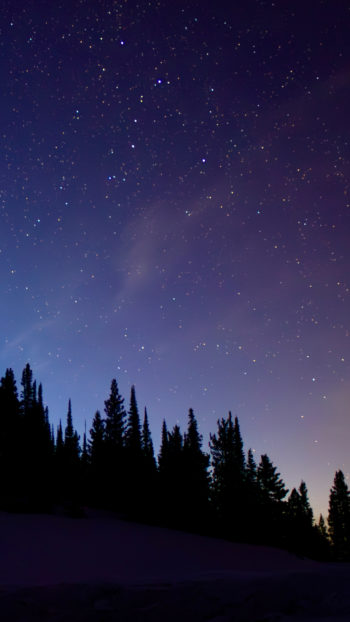
The aurora borealis, also known as the northern lights, is one of the most stunning natural sights visible from the Greater Yellowstone Ecosystem. The aurora is formed when charged particles from the sun interact with Earth’s magnetic field, sending electrons down through our atmosphere; the resulting emission of vibrant colors and bright glowing lights create gorgeous displays from Earth’s surface. The dark, clear skies of Yellowstone and the surrounding areas of Bozeman and Big Sky are the perfect venue for catching this astronomical marvel.

What is the Aurora Borealis?
Also known as the northern lights, the aurora borealis is a fantastic display of glowing colors shining overhead or on the horizon from a dark location. The aurora is especially visible at northern latitudes during the long nights of winter, making it an extra special treat for viewers in the Greater Yellowstone Ecosystem. Since the aurora is formed by charged particles from the sun, solar activity is an important factor for forming aurora; in winter 2026, activity from the sun will be at a peak, resulting in even more aurora opportunities.
Solar Wind and Charged Particles from the Sun
The charged particles emitted from the sun are called solar wind. This “wind” is really a stream of particles, like protons and electrons, which reach Earth and interact with our magnetosphere and then cause electron interactions with our atmosphere. Solar wind becomes more dense and more frequent during periods of high solar activity, like during the solar maximum happening during winter 2025-2026.
Interactions with Earth’s Magnetosphere
When the solar wind reaches Earth, it passes through our magnetosphere, the magnetic field around the Earth formed by our molten core. The charged particles in the solar wind interact with the magnetosphere and are directed toward the north and south poles. This interaction causes electrons to leave the magnetosphere and travel down through Earth’s atmosphere, the blanket of gas surrounding our planet. There, the electrons enter our atmosphere and interact with atmospheric gasses, resulting in emissions of bright, vibrant colors.

Aurora Coloration and Appearance
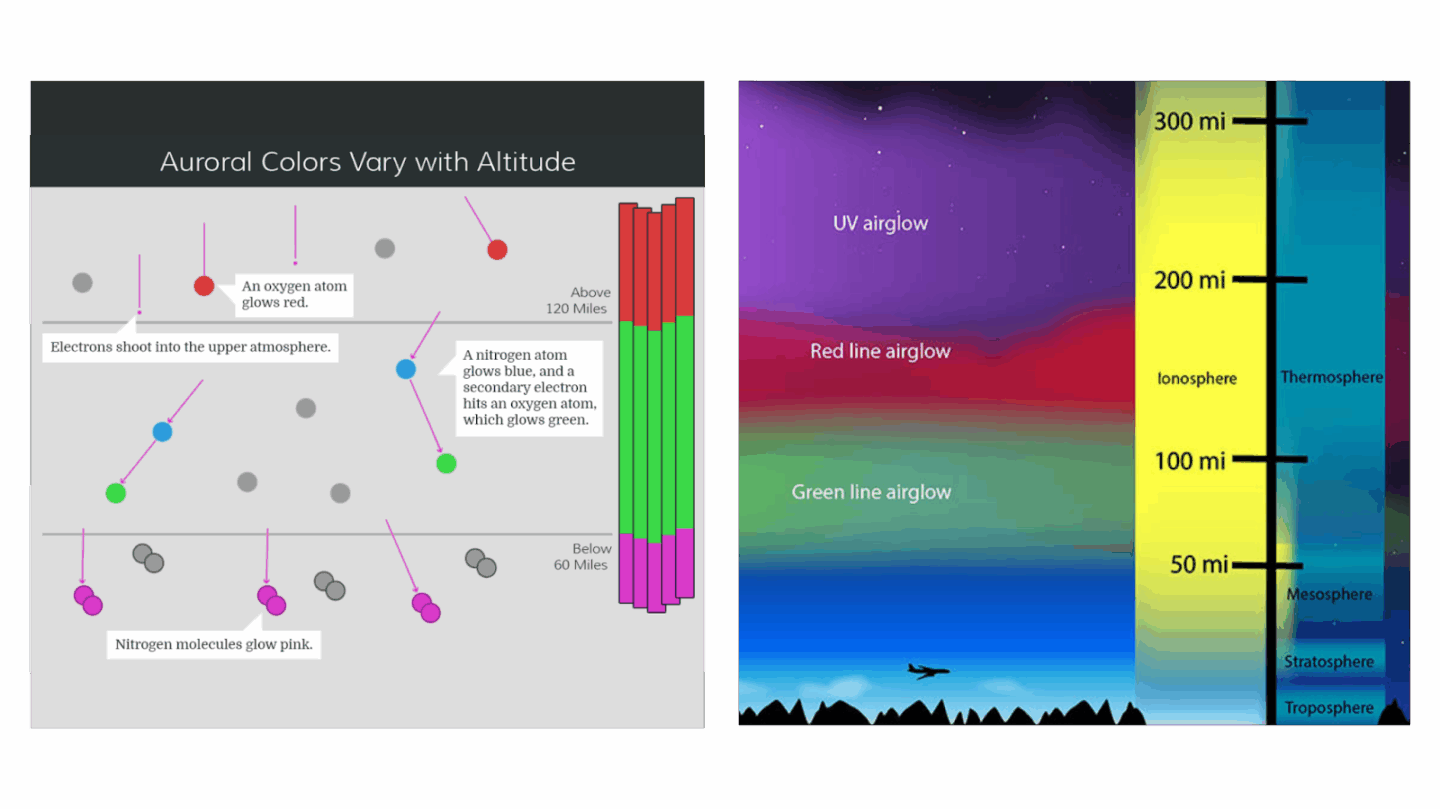
Earth’s atmosphere has many layers, and each layer contains different kinds of molecules. Red aurora are produced by excited oxygen molecules in the upper atmosphere, higher than about 120 miles above sea level; these oxygen excitations are most commonly caused by solar storms, so are especially common in winter 2026. Blue and green aurora are produced between 60 and 120 miles above sea level and are the result of nitrogen and oxygen atoms, respectively. Below 60 miles above sea level, pink aurora is produced by nitrogen molecules.
These colors can mix together, resulting in other colors like yellow, purple, and sometimes even white.
A Solar Maximum: Winter 2025-2026
Winter 2025-2026 is an especially good time to view the aurora. Our sun has a natural, predictable cycle of activity which has been observed for hundreds of years; this cycle changes the sun’s activity. We are at the peak of the sun’s activity now, which means that there is an increase in the amount of solar wind and solar storms coming from the sun. Because of this, aurora sightings are more common, especially in lower latitudes.
The Sun’s 11-Year Cycle
Humans have been observing the sun for thousands of years. Since the invention of the telescope in the early 1600s, these observations have become more precise and detailed; the first sunspots were observed in 1611, and we have been recording them ever since. These sunspot observations lead to a discovery: the number of sunspots peaks every 11 years. As scientific instruments have gotten more advanced in the years since, we have discovered that this 11 year cycle applies not only to sunspots, but to other solar activity as well.
Effects of a Solar Maximum
In 1859, English astronomer Richard Carrington observed a massive brightening on the surface of the sun. Later that day, the aurora was visible in latitudes much farther south than ever before recorded. This was the first recorded of a coronal mass ejection, or CME, affecting the aurora on Earth. These CMEs take time to reach the Earth, usually between 1 and 3 days, which make them a good way to predict when the aurora will be visible. During a solar maximum these CMEs are more common and more intense, leading to increased auroral activity.

How to View the Aurora
If you are interested in viewing the aurora borealis, good news! This winter is the best time to see the aurora, and this year will have the best aurora that we will see for the next 11 years. As with all celestial phenomena, the best thing you can do to prepare is get somewhere very dark such as the Greater Yellowstone Ecosystem. Head away from city lights, and if possible to high elevation. The farther north you are, the better chance you will have to see the aurora.
Space Weather Forecasts
In the modern era, the sun is under constant observation. Because of this, we often know when massive CMEs happen and are headed toward Earth. This gives us time to prepare for any effects from the ejections and gives us an opportunity to predict when the aurora might peak. Websites like the NOAA Aurora Dashboard are a great way to stay on top of the aurora. Apps like My Aurora Forecast can send you alerts when the probability of aurora is high in your area.
Location, Location, Location
Even more than with typical astronomical viewing, it is extremely important to think about your observing location if you want to see the aurora borealis. The farther north you can get, the better your chances of seeing the aurora! Even when massive CMEs hit Earth, the best views are still from northern latitudes. Be sure to find a spot with dark skies free from light pollution, and aim for a clear view north.
Help from Smart Devices
The aurora borealis can be a magical sight when seen with the naked eye, but smartphone cameras can pick up this phenomena even better than our human eyes can. A combination of digital processing and long exposure photography make the colors of an aurora really pop! Even if you can’t see the aurora with your naked eye, try turning your smartphone camera north and you might be able to capture pink or green skies, a telltale sign of an aurora.


Guided Winter Tours in the Greater Yellowstone Ecosystem
To enrich your aurora hunting experience, take a stargazing tour out of Bozeman or Big Sky! On a guided tour you can learn about many different astronomical events and view planets, nebulae, star clusters, and more through a computerized telescope. Seeing the aurora is not a guarantee, but if it does happen to be visible, a guided tour is the perfect way to learn photography tips to capture this once in a lifetime experience.
FAQs
When can I see the aurora borealis?
The aurora borealis is best seen during the long, clear nights of winter. Winter 2025-2026 is an especially good time to see the aurora since solar activity is at a maximum.
When is the best time to look for the aurora?
Aurora can appear at any time of night. Looking at a space weather forecast, such as those from NOAA, can help give you insight into the best time to look up.
Do I need a telescope to see the aurora?
Aurora are best seen with your naked eye. Lay back, relax, and take it all in!
Can I view the aurora in Big Sky or Bozeman?
Yes! Both Big Sky and Bozeman are excellent places to see the aurora. Be sure to get away from city lights; from Bozeman, try going to a location such as Hyalite Canyon. From Big Sky, trail heads like the Beehive Basin trailhead can give clear, unobstructed views.
Is there a risk of encountering wildlife while viewing the aurora?
As with any experience in the wilderness, wildlife could indeed be encountered while viewing the aurora. Stay aware of your surroundings while observing, and never stargaze alone.
Should I take a guided stargazing tour to see the aurora or go on my own?
Taking a guided tour is a great way to enrich your stargazing experience and create a memorable evening even if the aurora is not visible! While you can definitely chase the aurora on your own, the amenities provided by a guided tour such as a computerized telescope, chairs, blankets, snack, and drinks can make the experience extra special.
Wildlife Safari
Keep Exploring